

It's time for AI to meet Flow
Flow Engineering for AI

My friend Simon Mansfield, a Senior Manager, Solutions Architecture at GitLab Inc., recently shared an idea for a new role alongside a proposed job description: “AI Flow Engineer.”
Here’s why it’s needed:
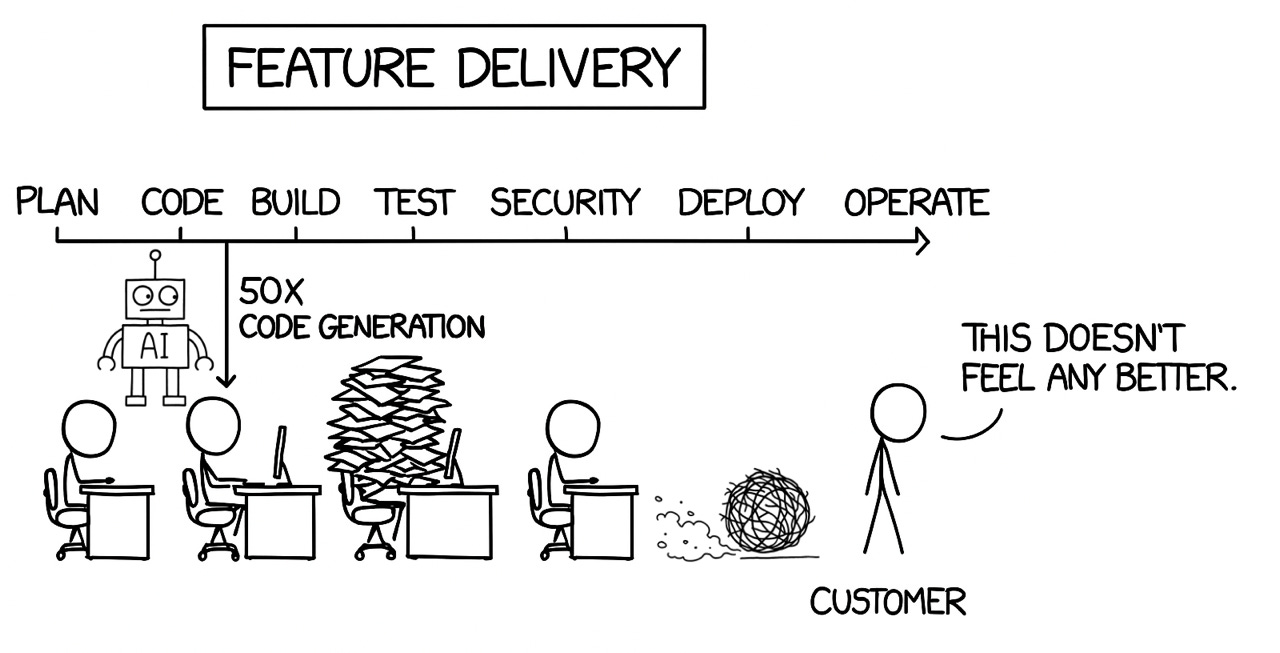
If this isn’t the first of my writings you’re seeing, you’re going to say something immediately: This isn’t just an AI problem.
You’re absolutely right.
We don’t just need AI Flow Engineers, we need Flow Engineers for every effort we’re undertaking.
So then, why does an AI Flow Engineer matter?
As I always remind myself: Meet people where they are.
Everyone is focused on AI, so if you want their attention, you’re going to have to step into the frame.
But this isn’t just bandwagon jumping. It’s a critical need.
Companies and teams are wasting months and millions on injecting AI either upstream or downstream of their constraint, and it’s only making things worse.
More AI output means more AI supported work to deal with the volume of crap being churned out everywhere.
Simon has touched on a growing need I’ve seen across many organizations: the need to move beyond isolated AI experiments and fragmented micro-optimizations, and instead take a holistic, systems-level approach to making work flow better.
The post sparked several conversations - with clients, colleagues, and operators - all circling the same core challenge: are we getting value here?
The answer isn’t more effort.
It’s not AI supported effort.
It’s better flow. Better flow where it matters most.
Inspired by Simon’s post, here’s the why, what, and how of this emerging need - and why it could be the key to unlocking real, sustainable performance in the age of AI.
The AI Flow Engineer: A New Kind of Role for a New Kind of Work
Many organizations find themselves working harder than ever - yet still struggling to move the needle where it counts.
Strategic goals are well-intentioned, but execution stalls. Teams are talented and eager but overwhelmed. Defined processes never meet reality. Despite significant investment in tools, systems, and transformation initiatives, bottlenecks and inefficiencies persist.
This isn’t because people aren’t working hard.
It’s because nobody owns flow.
Why Flow Matters More Than Ever
In every organization, across every function, work flows - or it doesn’t. It gets passed between teams, enters systems, awaits approvals, loops back for revisions, gets deprioritized, or gets stuck.
Most businesses aren’t lacking in energy, intelligence, or effort.
What they lack is flow visibility, clarity, and informed action.
This is where we believe a new kind of role is not just useful - but essential.
The AI Flow Engineer
If we really think AI can improve flow and outcomes, the answer isn’t everyone owning the problem. When everyone owns something, nobody owns it.
Focus drives results.
Flow Engineering for AI
The AI Flow Engineer’s mission is simple but essential:
Make the work work better.
This is done by:
Mapping how work actually flows - across teams, tools, and processes
Identifying what’s slowing it down - constraints, blockers, misalignments
Aligning stakeholders around what truly matters
Rapidly prototyping AI-powered solutions to remove bottlenecks
Enabling repeatable, scalable improvements through automation and shared understanding
The result? Less friction. More focus. Measurable acceleration.
Where This Role Fits - and Why It’s Needed
This role is not confined to a single department. It’s designed to oversee activity and respond to impediments to flow and value. That means:
Sales & Revenue Operations
Accelerate quoting, approvals, and onboarding with intelligent workflows.Customer Support & Success
Automate triage, follow-ups, and feedback loops to reduce cycle time.HR & Talent
Streamline hiring flows, employee onboarding, and internal mobility.Finance & Procurement
Eliminate delays in approvals, budget tracking, and vendor management.Product & Engineering
Improve coordination across product lifecycle, from ideation to launch.Marketing
Align campaign workflows across content, data, and digital execution.
Every function in a modern business has work moving through systems, tools, and people. In too many cases, that movement is unnecessarily constrained, invisible, or both. This role makes flow visible, and then makes it better.
How It Works in Practice
Flow Engineering operates in two distinct but connected phases:
1. Flow Mapping & Strategic Alignment
The AI Flow Engineer begins by running structured, high-impact mapping sessions with cross-functional teams. These sessions:
Clarify the outcomes that matter most
Visualize how work actually flows today
Identify blockers, wait times, and misaligned priorities
Facilitate agreement on what needs to change, and who owns what
It’s not just process mapping - it’s a collaborative reset that helps teams understand where they are and align on where they’re going.
2. AI-Powered Prototyping & Automation
Once the flow challenges are clear, the AI Flow Engineer builds working prototypes of solutions - using best-fit tools, including:
Visual platforms like n8n, Make, or Workato
Large Language Models (LLMs) like Claude, GPT-4, or open-source agents
Custom code, APIs, and scripts where needed to go beyond the limits of low-code tools
These prototypes are built fast - typically in 3–5 days - and are designed to show measurable impact immediately.
Note: These experiments aren’t new products or features for external customers - they’re for contributors and leaders, to better manage the system of work. Things like better metric data, dashboards, notifications, ‘andon’ cords, pairing practices, feedback loops etc etc
The list of things that support performance - that companies DON’T invest in - is a mile long!
Once validated, the solution is handed off to the business for scaling, while the AI Flow Engineer moves to the next opportunity.
Why Traditional Roles Can’t Fill This Gap Alone
You might be wondering: Don’t we already have operations teams, enablement, or IT to handle this?
Here’s the difference:
Operations teams often focus on executing within existing constraints, not redesigning the flow itself.
Enablement teams support adoption and training but don’t always have the mandate or skills to support real changes. ← this is the closest match
IT and dev teams are stretched thin, focused on large systems, not lightweight, iterative improvements.
Consultants can diagnose problems but rarely build and test real solutions on the ground.
The AI Flow Engineer bridges all of these, acting as a strategic facilitator, systems architect, and hands-on builder all in one.
The Superpower of Expert Facilitation
One of the most overlooked elements of this role is expert facilitation - the ability to bring stakeholders together across silos, build shared understanding, and create psychologically safe spaces to surface real challenges.
The AI Flow Engineer guides teams through ambiguity, asks the right questions, and creates momentum, turning tension into clarity and action.
In many ways, the conversation is the catalyst. The prototype is the proof.
How It Transforms the Business
Organizations that embrace this role see transformation at multiple levels:
🚀 Faster Delivery
Reduce lead times by 30–80%
Eliminate unnecessary handoffs, approvals, and rework
Accelerate time-to-value for customers and stakeholders
💰 Smarter AI Investments
Deploy automation where it actually solves flow constraints
Avoid “random acts of AI” that increase complexity or risk
See 10x ROI by focusing efforts where they move the needle
🤝 Stronger Alignment
Get diverse teams aligned on outcomes, not just tasks
Surface hidden dependencies and misaligned incentives
Build a shared language of “flow” across departments
🧠 Embedded Capability
Create reusable playbooks and automation patterns
Train teams to recognize and solve their own flow problems
Embed “flow-first” thinking into the culture
Success Isn’t Just a KPI, It’s a Shift
This role measures success in tangible ways:
Number of value streams improved
Working prototypes delivered
Time and cost savings achieved
Stakeholder alignment and adoption
Cultural momentum toward flow-first, automation-enabled work
But perhaps the biggest shift is intangible:
A business that feels more confident, focused, and capable of executing on its vision.
Final Thoughts: A Role Built for the Now
Flow Engineering is not a role — but the need for ownership and dedicated attention is a recognition that needs are changing, and the way we lead, design, and deliver work must change too.
We no longer live in a world where strategy and execution can be separate.
We no longer win by scaling effort; we win by scaling intelligence.
This role is about helping organizations move from complexity to clarity, from motion to momentum, and from isolated automation to intelligent flow.
If your teams are working hard but struggling to make progress -
If your AI investments aren’t delivering the impact you hoped for -
If you want your business to move smarter and faster, not just louder -
…it’s a clear way to make flow a priority.
As always - I’d love to hear your thoughts
Do you see a space for a role dedicated to internal AI investments in work flow?
And many many thanks to Simon for doing the heavy lifting on this!
Also cool
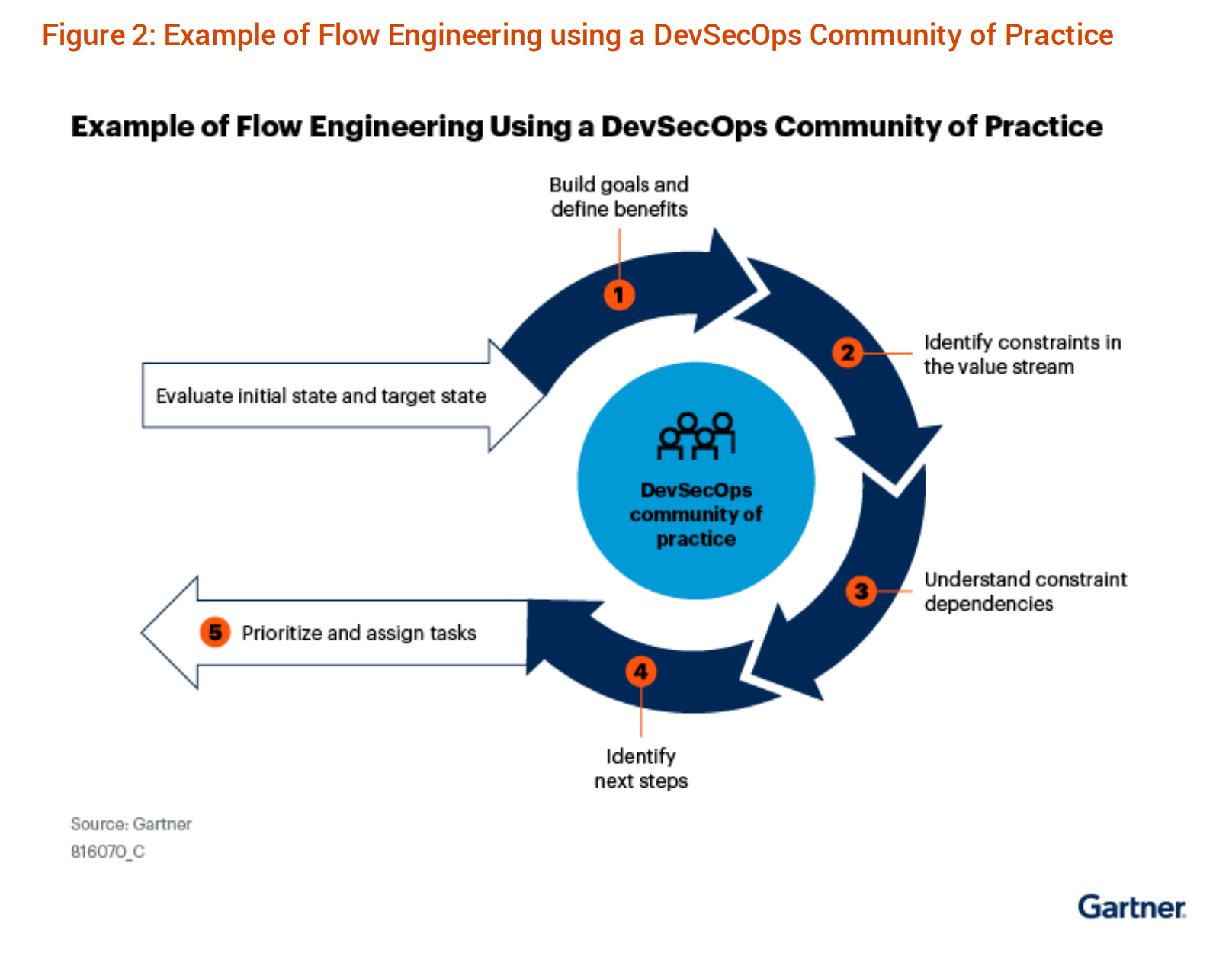
🤯 Flow Engineering hit Gartner’s radar (apparently last year!?!) and we just found out about it via the wonderful curator of all things value stream Patrice Corbard 🤯
Also: I’ll be at ETLS - will you?

Who should sponsor our book signing?! Let me know!
I'm always dubious new roles are need as they can create new silos. I prefer to think in terms of capabilities, what do teams need. What do systems need. What do organisations and communities need.
The underlying aspects make sense. Architecture. Product, Coaching and Facilitation etc all go together well with AI augmentation.