

FLOW + GROW
A combination for effective action at Individual & Collective scale

Most consultants use either people-focused coaching frameworks or systems-focused process improvement. Rarely both. But what if the most effective organizational change happens when you combine them?
The GROW Model and Flow Engineering seem like different tools for different jobs. One helps individuals discover their path forward through structured conversation. The other maps and optimizes how work flows through organizations. But they’re entirely complementary, allowing you to apply Value, Clarity & Flow at various scales.
GROW: A Framework for Clarity
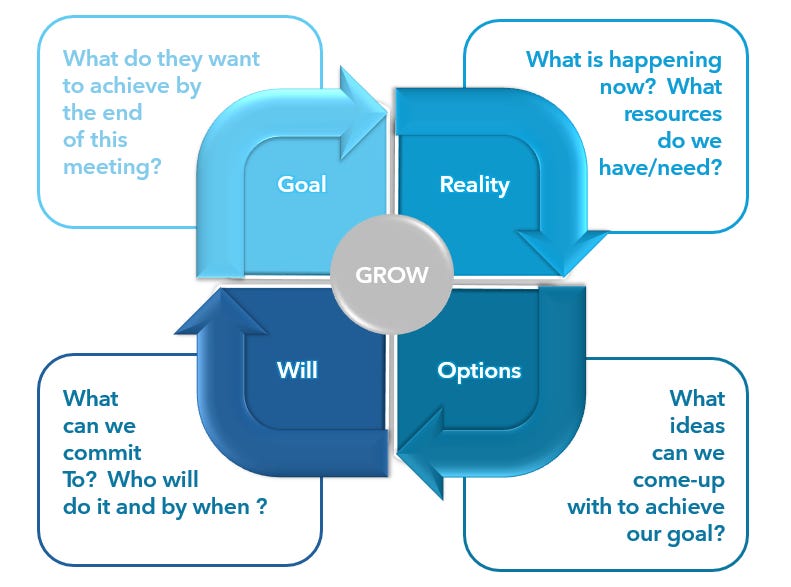
The GROW Model guides people through four stages: Goal, Reality, Options, and Will. It’s straightforward by design: helping individuals and teams articulate what they want, face current challenges honestly, explore possibilities, and commit to action.
The coachee drives the conversation.
The coach facilitates discovery.
How GROW Maps to Flow Engineering
Here’s where it gets interesting. Each stage of GROW aligns with specific Flow Engineering practices:
Goal
Define what you want to achieve. Goals should be clear and often follow the SMART criteria; specific, measurable, achievable, realistic, and time-bound.
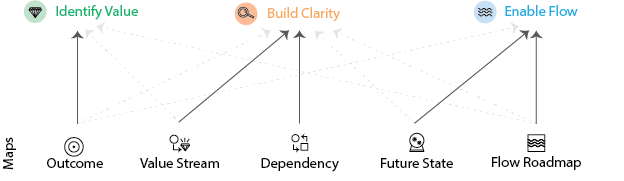
Outcome Discovery & Mapping (Target Outcome Definition, validated by Benefits, achievable and realistic via Obstacles)
Reality
Examine the current situation honestly, understanding where you stand in relation to the goal, identifying relevant facts and challenges.
Outcome Discovery & Mapping (general context gathering, surfacing pains, questions, ideas, and goals)
Current State Value Stream Mapping (documenting existing process steps, handoffs, cycle times, and wait states to understand where work actually happens today)
Dependency Mapping (identifying blocking relationships, resource constraints, and upstream/downstream impacts that affect current performance)
Options (or Obstacles)
Explore all possible strategies or ways to overcome obstacles to reach the goal, encouraging creative thinking and ownership.
Outcome Discovery & Mapping (general & initial obstacle gathering focused through the lens of the defined outcome)
Dependency Mapping (analyzing which dependencies can be eliminated, parallelized, or managed differently to create new possibilities)
Future State Value Stream Mapping (designing improved processes with reduced waste, faster flow, and clearer handoffs)
Will (or Way Forward)
Commit to specific actions and define the next steps to move toward achieving the goal.
Flow Roadmap (prioritization, batch sizing, ownership assignment, and measurement criteria)
Beyond Individual Coaching
GROW works beautifully for personal development and leadership coaching. It addresses mindset, motivation, and decision-making. But it doesn’t tackle the systemic issues; the workflows, bottlenecks, and organizational constraints that either enable or block progress.
That’s where Flow Engineering comes in. It maps the invisible currents of work: how value moves through the organization, where it gets stuck, and what accelerates or impedes progress. It relies on tangible artifacts (value stream maps, flow metrics, dependency graphs) that expose inefficiencies and guide improvement.
Why Not Both?

Personal clarity without systemic support fails. Flow optimization without individual buy-in and contribution stalls.
GROW creates the readiness and commitment for change at small scale
Flow Engineering provides the structural improvements that make change sustainable & systematic
For consultants, this means coaching individuals while simultaneously improving the systems they work within. You’re facilitating insight and redesigning flow. You’re bridging human potential and organizational capability.
Making It Work
Effective organizational improvement isn’t about choosing between coaching people or fixing flow. It’s about doing all that and more:
Use GROW to regularly help teams define clear outcomes and face reality
Map current state to understand systemic constraints
Explore options through both creative thinking and dependency analysis
Build roadmaps that assign ownership, set priorities, and define measurements
The leader who masters both amplifies impact dramatically. You’re not just helping people think differently or making processes better. You’re creating environments where clear intentions flow through well-designed systems.
Change stops being fragmented. It becomes coherent movement; aligning people, purpose, and process into actual progress.
Want to explore how these frameworks work together in your organization? That’s exactly what Flow Engineering workshops are designed to do.